Mostrar mensagens com a etiqueta Scotland. Mostrar todas as mensagens

quinta-feira, 28 de julho de 2011

David Byrne & Brian Eno - My Life In The Bush Of Ghosts


David Byrne & Brian Eno
My Life In The Bush Of Ghosts
1981
Experimental Art Rock
Scotland / England


Tracklist:


     Side one
"America Is Waiting"
"Mea Culpa"
"Regiment"
"Help Me Somebody"
"The Jezebel Spirit"
     Side two
"Qu'ran"
"Moonlight in Glory"
"The Carrier"
"A Secret Life"
"Come with Us"
"Mountain of Needles"


     My Life in the Bush of Ghosts is a 1981 album by Brian Eno and David Byrne, titled after Amos Tutuola's 1954 novel of the same name. The album was re-released in expanded form in 2006.
     Receiving strong reviews upon its release, My Life is now regarded as a high point in the discographies of Eno and Byrne. In a 1985 interview, singer Kate Bush remarked that the album "left a very big mark on popular music," while critic John Bush describes it as a "pioneering work for countless styles connected to electronics, ambience, and Third World music." The extensive use of sampling on My Life is widely considered ground-breaking—it was one of the first albums to do so—but its actual influence on the sample-based music genres that later emerged continues to be debated.
     The album was recorded entirely with analogue technology, before the advent of digital sequencing and MIDI. The sampled voices were synchronized with the instrumental tracks via trial and error, a practice that was often frustrating, but which also produced several happy accidents.
     Also according to Byrne's 2006 notes, neither he nor Eno had read Tutuola's novel before the album was recorded. Both were familiar with Tutuola's earlier The Palm-Wine Drinkard (1952), but his My Life in the Bush of Ghosts was not easily obtained in the U.S. when the material was recorded. Even without reading the book, Eno and Byrne thought the title reflected their interest in African music, and also had an evocative, vaguely sinister quality that also referenced the voices sampled for the album: the vocalists were recorded sometimes several decades before being re-appropriated by Eno and Byrne, and the voices often seemed to take on unanticipated qualities when placed in the new context.

     Personnel

David Byrne and Brian Eno – guitars, bass guitars, synthesizers, drums, percussion, found objects
John Cooksey – drums on "Help Me Somebody" and "Qu'ran"
Chris Frantz – drums on "Regiment"
Busta Jones – bass guitar on "Regiment"
Dennis Keeley – bodhran on "Mea Culpa"
Bill Laswell – bass guitar on "America Is Waiting"
Mingo Lewis – bata, sticks on "The Jezebel Spirit" and "The Carrier"
Prairie Prince – can, bass drum on "The Jezebel Spirit" and "The Carrier"
Jose Rossy – congas, agong-gong on "Moonlight in Glory"
Steve Scales – congas, metals on "Help Me Somebody"
David van Tieghem – drums, percussion on "America Is Waiting" and "Regiment"
Tim Wright – click bass on "America Is Waiting"
Rooks on "Help Me Somebody" courtesy of April Potts, recorded at Eglingham Hall


quarta-feira, 20 de julho de 2011

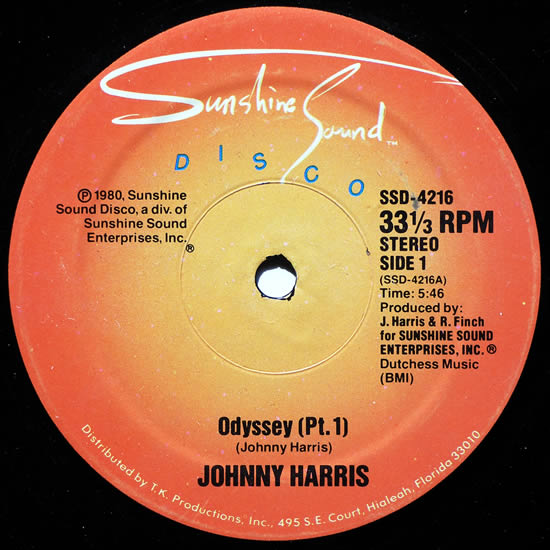
Johnny Harris - Odyssey


Johnny Harris
Odyssey
1980
Electronic Funk Disco
Scotland


Tracklist:

01.Odyssey (Part.1)
02.Odyssey (Part.2)


     Johnny Harris (born John Stanley Livingstone Harris, 1932) is a Scottish born composer, producer, arranger, conductor and musical director. He was born in Edinburgh, Scotland; and a graduate of the Guildhall School of Music in London. He has lived in the US since 1972.      Originally a member of the short-lived beat group The Shubdubs with drummer Jimmie Nicol and organist Roger Coulam, he joined PYE Records in 1965 as an arranger working alongside Peter Knight and Tony Hatch. He arranged, conducted and produced the majority of tracks on the Shirley Bassey albums "Something", "Something Else", "I Capricorn", "And I Love You So", "Never Never Never" and "All By Myself". He was the regular musical director for the BBC light entertainment show Happening For Lulu in 1968-69 starring singer Lulu and conducted her Eurovision Song Contest winner Boom Bang-A-Bang in 1969. He was the musical director for the BBC/ZDF co-production Pop Go The Sixties broadcast on BBC1 on 31 December 1969 as well for BBC shows for Georgie Fame, Petula Clark, Mike and Bernie Winters and actor-singer Keith Michell.
     He composed the scores for several cult movies including Fragment of Fear (1970), I Want What I Want (1972) and Man in the Wilderness (1971).
     His 1980 underground hit 'Odyssey' (TK Records) featured prominently on popular video game Grand Theft Auto: San Andreas playing on Bounce FM funk radio, as well as being in the lowrider challenge mission. The song was also featured in the Buck Rogers in the 25th Century episode "Space Rockers" (Harris originally wrote the song for that episode).


quarta-feira, 29 de junho de 2011

Positive Noise - Charm 7''


Positive Noise
Charm 7''
1981
New Wave Post Punk Synthpop
Scotland


Tracklist:

01. Charm
02. ...and Yet again


     Positive Noise were a New Wave and Synthpop band from Scotland who had a number of indie hits in the 1980s. They released three albums and several singles and were together for over five years.
     The band was formed in 1979 by Ross Middleton (vocals), his brothers Graham Middleton (keyboards, vocals) and Fraser Middleton (bass guitar, vocals), Russell Blackstock (guitar, vocals), and Les Gaff (drums). Their first released material was two tracks ("Refugees" and "The Long March") on the Statik label compilation album Second City Statik in 1980, and they followed this with two singles on Statik in 1981, both of which were top-ten hits on the UK Independent Chart. Début album Heart of Darkness was released in May 1981, after which Ross left to form the short-lived Leisure Process, with Blackstock taking over on lead vocals. Heart of Darkness peaked at number four on the independent chart, and the band's second album, Change of Heart (1982), also charted, reaching number 21. They released a third and final album, Distant Fires, in 1985, now with John Telford on drums and John Coletta on guitar, but their earlier success was not repeated and they split up shortly afterwards.
     Ross Middleton went on to work as a music journalist, writing for Sounds under the pen name Maxwell Park.


Discography

     Albums
Heart of Darkness (1981) - came with a bonus 7-inch single: "Love Like Property"
Change of Heart (1982)
Distant Fires (1985)
     Singles
"Give Me Passion" (1981)
"Charm" (1981)
"Positive Negative (1981)
"Waiting for the Seventh Man" (1982)
"Get Up And Go" (1982)
"When the Lightning Strikes" (1983)
"A Million Miles Away (1984)
"Distant Fires" (1985)


quarta-feira, 18 de maio de 2011

Positive Noise - Give Me Passion EP


Positive Noise
Give Me Passion EP
1981
New Wave Synthpop
Scotland


Tracklist:

01. Give Me Passion
02. Ghosts
03. End Of A Dream


     Positive Noise were a New Wave and Synthpop band from Scotland who had a number of indie hits in the 1980s. They released three albums and several singles and were together for over five years.
     The band was formed in 1979 by Ross Middleton (vocals), his brothers Graham Middleton (keyboards, vocals) and Fraser Middleton (bass guitar, vocals), Russell Blackstock (guitar, vocals), and Les Gaff (drums).        Their first released material was two tracks ("Refugees" and "The Long March") on the Statik label compilation album Second City Statik in 1980, and they followed this with two singles on Statik in 1981, both of which were top-ten hits on the UK Independent Chart. Début album Heart of Darkness was released in May 1981, after which Ross left ot form the short-lived Leisure Process, with Blackstock taking over on lead vocals. Heart of Darkness peaked at number four on the independent chart, and the band's second album, Change of Heart (1982), also charted, reaching number 21. They released a third and final album, Distant Fires, in 1985, now with John Telford on drums and John Coletta on guitar, but their earlier success was not repeated and they split up shortly afterwards.
     Ross Middleton went on to work as a music journalist, writing for Sounds under the pen name Maxwell Park.